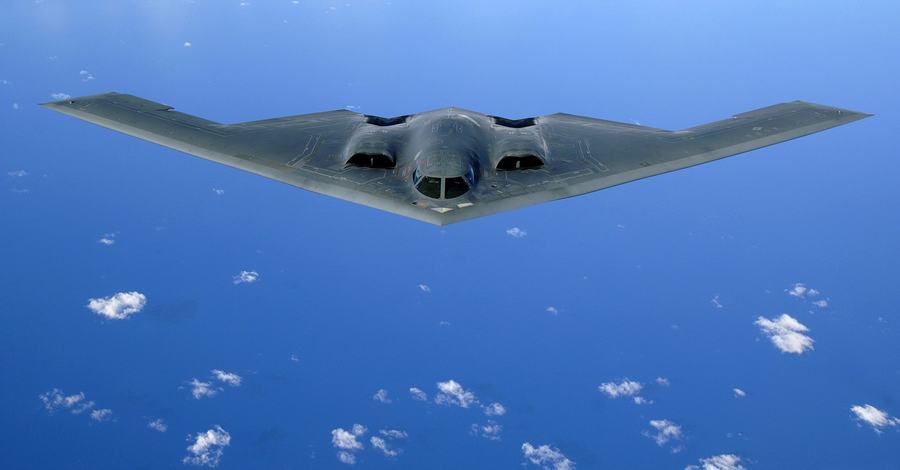
The B-21 Raider has made its first weapon release, with digital twin modelling used to prepare the drop. Also in the briefing: a planned M5 closure at Exminster Viaduct, a study on cutting bipolar plate costs, and a new multi-laser metal 3D printer.
B-21 Raider makes first weapon release, backed by digital twin modelling
The US Air Force reports that in the first week of November, a B-21 test aircraft operating out of Edwards Air Force Base, California, let go of a conventional weapon. This marks the first time Northrop Grumman's bomber has done so. The Air Force says the Raider Combined Test Force leaned heavily on modeling in the B-21's digital twin environment, simulating the weapon's behavior and refining its trajectory ahead of the physical drop. The service also said the test validated the aircraft's open-systems architecture. Northrop Grumman separately said that its airframe fatigue testing, covering multiple lifetimes, was finished several months before the planned date.
Why it matters: A physical release test that leans on a digital twin to set up the trajectory shows how simulation can shape the test plan itself. It also raises the question of how closely the model's predictions are compared against the flight data afterwards.
Source: Aerospace Testing International — Northrop Grumman B-21 Raider completes first weapons release test
Fraunhofer IWU study: hollow embossing rolling cuts bipolar plate cost by ~30%
Researchers Franz Reuther and Ricardo Trân at Fraunhofer IWU compared continuous hollow embossing rolling with conventional hollow embossing for metallic bipolar half-plates, in a study published in Production Engineering. In their reference scenario, total cost falls from €1.13 to €0.82 per half-plate, around 30%. Forming forces are about one-tenth of those in pressing, and adjusted throughput rises from 35 to 82 plates per minute. The authors assumed higher scrap and unplanned losses for rolling because industrial experience is limited. Across varied tooling, material and throughput assumptions, they report realistic savings of 20% to 40%. Numerical analyses put the rolling force below 10% of the pressing force, depending on plate design.
Why it matters: The low forming forces came from numerical analyses, so forming simulation sits at the heart of this case. Teams weighing a process change will want to see how well those force predictions hold up against measured results on real tooling.
M5 closure over Christmas to remove corroded safety deck at Exminster Viaduct
National Highways says the M5 will shut between junctions 30 and 31 from 8pm on Christmas Eve until 6am on Boxing Day. The aim is to remove a corroded steel safety deck, installed in 1977, from beneath Exminster Viaduct near Exeter. The date was chosen because no trains run on the railway below at that time. The deck will not be replaced, since the parapets were raised and steel infill panels added in 2014. Two 150t cranes will lift out the structure, with protective sheeting over the tracks while the girders are turned and taken out through the gap between the carriageways. Mesh netting will remain to catch smaller debris.
Why it matters: The job packs a lifting and handling sequence over a live railway into a very short window. It shows how much depends on checking each stage in advance, including crane loads and the movement of the girders.
Source: New Civil Engineer — M5 J30 to 31 to close over Christmas for removal of corroded safety deck
Eplus3D unveils EP-M550L metal printer with up to 16 lasers
Eplus3D, based in Hangzhou, has introduced the EP-M550L, a powder bed fusion system built for high-volume batch production. It has a 550 x 550 x 600 mm build volume and can be configured with 8, 9, 12, or 16 lasers, at 500 W, 700 W, or 1000 W. The company quotes a theoretical printing speed of up to 560 cm³/h. It also says accuracy and process consistency are maintained across the multi-laser setups. A removable build cylinder and automated powder handling are meant to ease changeovers between builds. Eplus3D has not disclosed pricing or delivery timelines.
Why it matters: Multi-laser machines raise questions about how consistent the result is across the whole plate, and a theoretical speed is not a measured one. Anyone qualifying parts from such a system will want data from their own builds.